Showing posts with label container garden. Show all posts

Wednesday, 1 August 2018

Fig tree collection has doubled - now a certified "figaholic"

The new bare root trees arrived 30th June.


After transplanting, I've reached 55 large pots (5 gal/20 liter) and 17 black plastic bags of duplicates plus  3 varieties of cutting I'm trying to root, making at least 30 different varieties altogether. I ran out of space long ago.

Yellow labels are known varieties from Stark Ayres in Cape Town, brown labels are sourced in PE, Grahamstown and Kenton and pretty much "unknown".

Blue labels in green pots are the new bare root trees purchased from Gerhard at Giving Trees in Vereeniging (another "figaholic" but one who actually owns and runs a commercial nursery so it's a sort of job requirement), and are correctly identified.


As if that wasn't enough, the most recent bare rooted batch arrived from Gerhard on 30 July, making an extra 3 pots, 2 black bags and umpteen extra cuttings:


 A duplicate Cape Black and Ficazzana Black (Smyrna type) into bags:


Cape Black, Ficazzana Black and Malta Black (latter two Smyrna types) in pots but before labelling and  cutting back:


Collection at present consists of:

Common figs: Adam, Alma, Blackjack, Black Mission, Cape Black, Cape Brown, Cape White, Col de Dame Grise, Col de Dame Noire, Dalmatie, Deanna, Dauphine, Kadota, Noire de Barbentane, Noire de Caromb, Parisian, Pastiliere, Tangiers (Zidi?), Ronde de Bordeaux, Roxo de Valinhos, Tena, Tiger, White Genoa, Violette de Bordeaux

Cuttings:Sucre Verte (cuttings), Sultane (cuttings), Tangiers (both a tree from Starke Ayres and cuttings from Gerhard - tree may be a Zidi)

Smyrna: Black Malta, Ficazzana Black, Smyrna/Calimyrna, Caprifig Roeding 3 and a seedling fig from my garden

Unknown: Assorted local Avignon and Toulouse (which may or may not be Dauphine and Ronde de Bordeaux respectively) and several claiming to be Cape Brown, Kadota and Adam but most certainly aren't, plus "Black" and "Violet" figs. Also some cuttings from friends with so far unidentified trees.

Gerhard's web site has a good description of many of these fig varieties.

I'm happy to trade cuttings or duplicates when these trees are larger. Please leave a comment.

Rooting fig cuttings

I've been trying to root fig cuttings with limited success (two out of perhaps forty) but at last seem to be getting somewhere.

The first "method" was pretty arbitrary - stick some cuttings into a black plastic bag of compost placed where they get occasionally misted. The cuttings stayed alive for a very long time but did nothing. They eventually rotted due to drowning. The compost had compacted and wasn't draining.

The second method was putting some cuttings into an aluminium tray in mixed vermiculite and sand in a Ziploc bag and leaving it outside for a few months without additional water. When opened up, about 50% of the short two node cuttings had rooted and got a few leaves. These were transplanted into a small plastic pot of compost, and one cutting of each variety seems to have taken.

The third method was to use transparent plastic cups filled with vermiculite, coarse sand and bark mulch. Most cuttings were about three nodes. These were left outside under occasional misting, and a few - to my surprise - rooted. Siimilarly transplanted to small pots of compost, where a few have taken.


The fourth method is the so-called "fig-pop" where a 10cm x 50cm plastic bag has about 20cm of mixed vermiculite, sand and compressed/reconstituted coir and the cutting placed in it. The base is pricked with a tooth pick for drainage, and the top folded over and stapled after drenching with water.
Over time, the mix has varied, the best results favouring 50/50 vermiculite/coir and leaving out the sand.

Initially they were left inside in a darkened room, but developed mold after a few days, Taking them outside into the light and leaving them there seemed to sort that out.

I've had mixed success with this... initially nothing much happened and a fair number died because of lack of moisture, After topping them up with water and ignoring them for a few months, quite a few have developed roots and grown leaves, but the roots are not yet that extensive.

The fifth, and so far "best" method, is the third method with the addition of putting the plastic cups into large transparent plastic storage boxes - a mini greenhouse sort of arrangement - and leaving them outside to control mold.


The issue now is how moist to keep the cups and whether to leave the boxes in the sun - it's starting to warm up. The developing roots clearly don't like the sun, so I've started putting the cups with developed roots into darker cups.

In a week or so, the next step will be to "up-pot" the established cuttings. It's still a bit cold for that, though.

Then the decision as to what to actually do with perhaps several hundred small fig trees. My problem is that every pruned branch from my collection of trees gets converted into several three or four node cuttings.

Saturday, 27 May 2017

Fig tree expansion

I've managed to find some properly labelled fig trees at the Starke Ayres garden centre in Cape Town.

I now at last have a real "Adams" fig tree, and a proper "Kadota", to replace the ones I bought at the Sunnyside nursery in Grahamstown. Comparing the trees, small as they are, it's obvious they're different, and the ones from Starke Ayres match other pictures from the web of the Adams and Kadota.

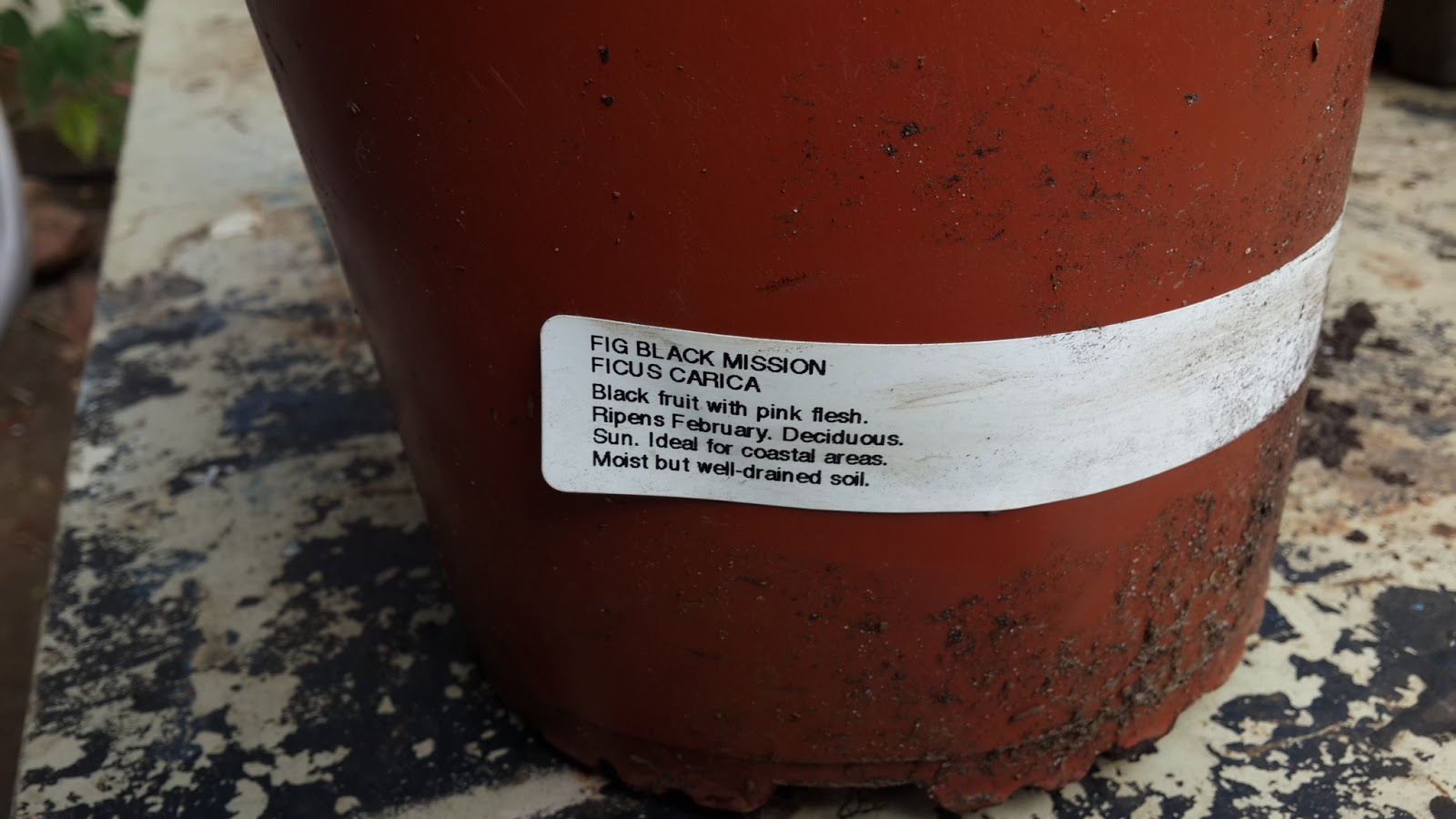
Additionally, assuming the labels are accurate, I got nice healthy specimens of "Deanna", "Parisian", "Black Mission", and "Tangier". Tangier is apparently a Smyrna fig variety that needs to be pollinated, so it might not be very successful.

The new arrivals survived the trip from Cape Town in the back of an open bakkie without suffering much wind damage and still have to be put into pots.

Together with the seven trees I already had, this makes thirteeen in pots in total, plus the old original planted in the ground. So, there are three of uncertain parentage -- the fake Kadota and Adams and the old original. Identifying these will be a challenge...

The older ones -- with labels from Sunnyside, so might be misleading -- are "White Genoa", "Cape Brown", "Cape White", "Avignon" and "Black Toulouse". The White Genoa is from 2015 or so, while the others are from late 2016 or early 2017.


In addition to all the above, I have a bird propagated fig seedling that I found in the garden and transplanted into a large black bag. It's doing well, but too young to fruit. The new Deanna is a very tall and sturdy whip, so it might be possible to prune it way back and try to propagate from the cut off bit.


Black Mission.... I messed up by trying to detach the sucker and half broke the main plants connection to the root mass. After transplanting, it's badly wilted.

Planted the sucker in small pot.


Kadota


.
Parisian


Adam... the real one.


Deanna


Tangier

Thursday, 11 May 2017

Peas


Sugar snap climbers - supposedly a summer crop?


Mangetout Kennedy and Greenfeast.

Thursday, 19 January 2017

Unknown 2 fig

The 7th fig of the collection.

It's not clear this is actually an Adam - the leaves look a lot like the Avignon and the Toulouse, while the Adam is supposed to have hardly any indentations...

It's said the Adam and the Avignon are the same? Even though the Avignon is supposedly a San Pedro type?


Update 2017/05/27:

This is not an Adams fig. I purchased a proper one a few days ago and it looks nothing like this impostor... which leaves the question of trying to work out what it really is.

Black Toulouse fig [Ronde de Bordeaux?]


In its medium size pot, even though this fig could bear heavily...

Moved to a new position:


Cape Brown fig [Osbornes prolific]

It seems to be affected by the fig mosaic virus, but then this variety suffers badly.


Before transplanting. Note the low side shoot.


In its 45cm pot.


Discoloured leaves from fig mosaic virus.


Update 2017/02/08:


Update 2017/02/20:


Tuesday, 10 January 2017

Cape White fig tree [Blanche or White Marseilles]


Yet another addition to the forest of figs in pots. A nice healthy specimen of a Cape White fig..

Properly known elsewhere as a Marseillaise. Or "testicles of the pope"!

Recommended for growing in pots and for drying.


Update 2017/01/16:

Description from "The Fig" by Ira Condit (1947):

"Marseilles (White Marseilles, Lemon). Marseilles is probably of French origin. It is illustrated in color by Brookshaw (1812) from fruit grown in the garden of the Episcopal Palace at Lambeth, England. In England the tree grows well in pots or as an outdoor standard and bears both a first and second crop. The following three varieties were included in the Chiswick collection and proved to be identical to Marseilles: Figuier Blanche No. 18904, Vigassotte Bianco No. 18864, and Quarteria No. 18866. It is of no commercial value in California.


Breba crop small; figs medium, turbinate with short, thick neck and short stalk; eye medium, open; flecks small, green; color yellowish green; pulp white; seeds large, conspicuous. Figs of second crop much the same as brebas; spherical to oblate, without neck; stalk slender up to Y* inch long; quality fair."

Update 2017/01/19:


Moved to a 45cm pot. The smaller pot went to the Black Toulouse.


Update 2017/02/07:

Looks like a mystery has been solved. We've had a fig tree in the garden for 25 years or so. It used to bear reasonably well, then got crowded out by a pecan tree and a mulberry, plus fence and compost heap and gate.

For whatever reason, this year it's producing, and given my recent enthusiasm for figs, it's going to be subject to "renovation". There's some accessible fruit, and today I noticed one ripe fig:


From what I can make out, it's a Cape White. So...

Update 2017/05/29:

No, it's not. The shape and colour of the fig, and the shape of the leaf make this a Calimyrna of some sort. Which explains why it was able to generate a seedling?

This is getting quite interesting....


Avignon fig tree [Dauphine?]


The latest addition to the fig trees in pots orchard, labelled Avignon fig.. A bit thin and spindly, but healthy.

Green and purple fruit. This is my first "complicated" fig, a San Pedro type that  requires caprification for the main crop.

Proper name for this everywhere else is Dauphine.


Update 2017/01/16:

Description from "The Fig" by Ira Condit (1947):

"Dauphine (Ronde Violette Hative, Adam, Pagaudiere). The Dauphine is commonly grown at Argenteuil near Paris for the fresh fruit market. It came to California in the Chiswick collection as P. I. No. 18912 but has not been planted commercially.


Breba crop good; figs medium to large, broadly turbinate, with short, thick neck and short stalk; eye large, open; surface glossy with pruinose bloom; color violet-purple; meat thick; pulp strawberry; quality good. Second-crop figs medium, oblate, mostly without neck, similar to brebas in other characters; quality fair to poor."

Update 2017/01/20:

Moved (point of being in a pot) and strapped to a stake to improve its posture:


Thursday, 29 December 2016

Unknown 1 fig tree

Update 2017/05/29: Sold as a Kadota, but most likely Col de Dame Grise?


I've recently found out that fig trees do well in containers, so this Kadota fig recently joined the garden:


It's a reasonable size - about 1 metre tall, and is in the largest pot I could find. There are about 5 figs on it that haven't fallen off yet.

Apparently the Cape Brown and Cape White are good dwarf variety fig trees for containers, and I will get these set up in pots as soon as some healthy specimens are available.

Already planted in the ground in the garden is a White Genoa which is slowly settling in after a year of neglect standing in a black plastic bag. There is space for another in the ground and I'd like to plant a variety called Parisian, but this might not be readily available so will probably end up as a Black Mission.

The fact figs do well (or at least OK) in pots, gives some scope for experimentation.

Update 2017/01/10:


Showing good signs of growth after about two weeks in the pot, with new leaves on many of the stems.

Apparently this variety is rarely seen without figs, making it difficult for young plants to get established. Does this mean knocking them off? Reluctant to do so...

Got myself a Cape White,and an Avignon, but the Cape Browns for sale still don't look healthy - they're supposedly very susceptible to the fig mosaic virus which messes up their leaves.

Update 2017/01/16:

Description from "The Fig" by Ira Condit (1947):

"Dottato (Kadota, White Pacific, White Endich). Dottato is the principal drying fig of southern Italy where it has probably been grown for centuries. It may be the same variety which Pliny said was brought by Lucius Vitellius from Soria to his villa at Alba. The name comes from the Italian fico addattato, or adapted fig, undoubtedly referring to its wide adaptability to soils and climatic conditions as well as to possible uses. The literature on this fig, its history, culture, and uses has been reviewed by Condit in 1920 and 1927. In California it forms the basis of the canned fig industry and is also marketed both fresh and dried. The tree bears two crops.

Brebas large, pyriform with a distinct, thick neck; color green or yellowish green; meat and pulp violet tinted, sweet and rich; quality excellent. Figs of the second crop medium, spherical to short-pyriform; stalk up to $4 incn long; eye medium, closed by scales, often sealed with a drop of clear gum; skin greenish yellow to lemon-yellow; pulp amber, almost seedless, sweet but lacking character. In cool coastal districts, figs pyriform, grass green, with violet-tinted meat and pulp."

Update 2017/01/21:

An ichneumon fly caught in the act of sucking sap out of a baby Kadota fig. It sat there for a good half hour, just like a fruit mosquito. Struggled to get focus.


The insect was about 20mm long and darkish brown. The fig it was attacking maybe 2mm across. It looked like it knew exactly what it was doing.


Update 2017/02/20:


Update 2017/03/25:

Unexpectedly!


These have suddenly started getting bigger and ripening.. and to think I nearly pulled them off a month or two back.

It's getting quite cool in the evenings and the tree isn't getting that much sun at this time of the year.


The breba crop for next season?

In passing, the figs all ripened, but didn't taste that wonderful.

Update 2017/03/27:

I'm not sure this is actually a Kadota? The colour and shape of the ripening fruit are wrong, as is the date of ripening - it's very late. In the Lotter fig book, the most likely candidate is a Brown Turkey fig, but who knows?

I'm starting to strongly suspect that none of the labels on the figs I have purchased are even remotely correct!

Update 2017/05/27:

This fig is definitely not a Kadota. I bought a real Kadota a few days back from Starke Ayres, and it looks nothing like this. So, what did I buy from Sunnyside?

Update 2017/05/29:

Perhaps a Col de Dame Grise? The following description/characteristics seem true, apart from the flesh colour:

"One of the latest ripening figs. The main crop ripens from March onwards and sometimes even into winter."

"Rated as one of the best tasting fig varieties available. Keep in mind that taste differs though.
It is not overly sweet with distinctive savoury undertones."
Update 2017/05/29:

Or a Brown Turkey? The thin neck of this fig isn't right for a CDG....
Or Brunswick?